


Fo Guang Shan Hsi Lai Temple
"Why is it that we seem enlightened when speaking about the Dharma, yet become confused when confronted by circumstances? Have you ever reflected on this?"
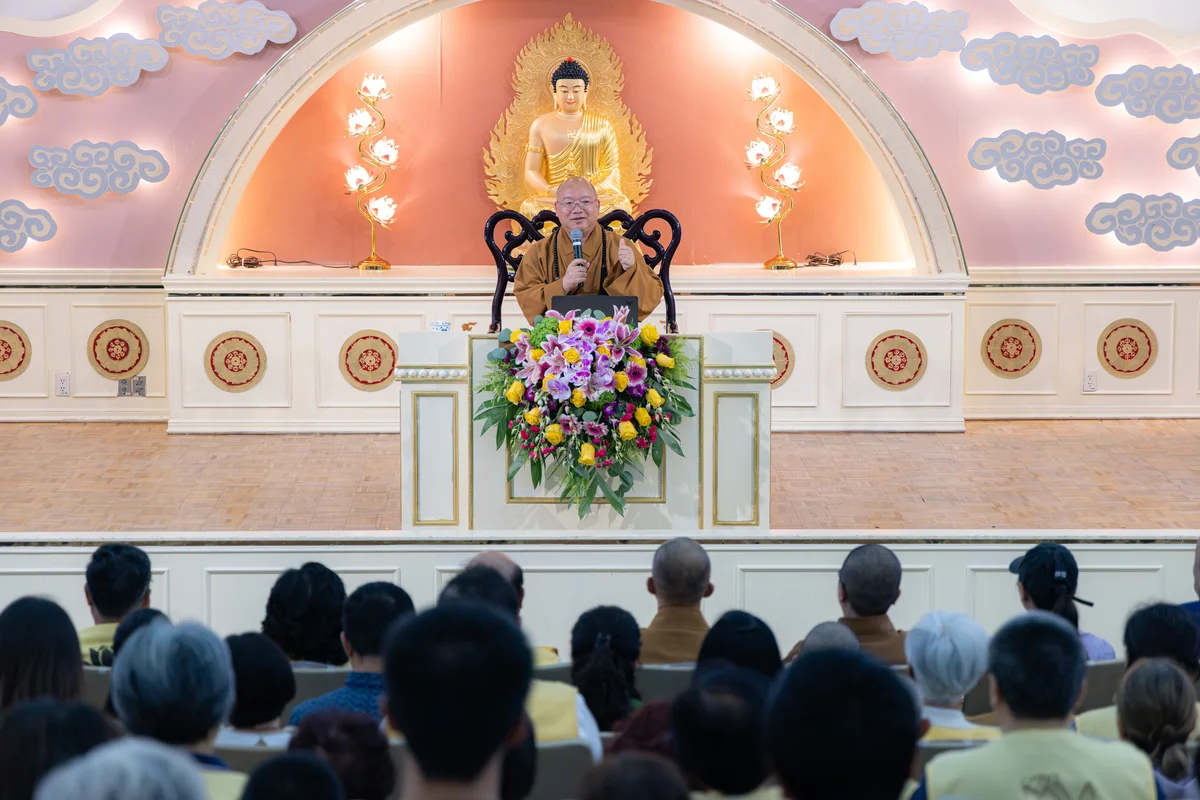
With this question, Most Venerable Hsin Bau, Abbot of Fo Guang Shan, opened a Buddhist lecture at Hsi Lai Temple on July 18 titled "Hanshan, Shide and the Chan Masters' Verses." Drawing on the poetry of the two legendary Chan masters Hanshan and Shide, Most Venerable Hsin Bau encouraged the audience to turn inward and examine their own minds. Through hearing, reflection, and practice, he guided participants toward realizing non-self, transforming afflictions, and cultivating greater freedom and inner clarity.
The lecture featured simultaneous English interpretation. Both the Dharma Hall and the adjacent auditorium were filled to capacity, with nearly 450 people attending in person and via livestream.
Most Venerable Hsin Bau explained that Hanshan and Shide, two Chan practitioners associated with Guoqing Temple on Tiantai Mountain during the Tang dynasty, are traditionally regarded as manifestations of Manjusri and Samantabhadra Bodhisattvas. During the Qing dynasty, Emperor Yongzheng honored them as the "Two Sages of Harmony." Their images as pure, carefree Chan practitioners represent an ideal long sought by people in the world.
But why do people so often "seem enlightened when speaking, yet become confused when facing circumstances"? Most Venerable Hsin Bau said the key lies in realizing non-self.
Many people study Buddhism only by listening to teachings, he noted, without engaging in proper reflection or actual practice. The Buddha's teaching of the Four Factors Leading to Stream Entry—drawing close to good spiritual friends, hearing the true Dharma, wise reflection, and practicing in accordance with the Dharma—provides a progression from hearing to contemplation and ultimately to practice.
Most Venerable Hsin Bau cited the Heart Sutra, which teaches that by "seeing the emptiness of the five aggregates," one can transcend suffering, as well as the Diamond Sutra, which teaches letting go of attachment to notions of self, person, and sentient beings. These teachings, he explained, guide practitioners to break through attachment and realize emptiness.
Ordinary people, however, tend to regard the five aggregates as a real and permanent self. Once attachment to the self arises, greed, anger, ignorance, and other afflictions follow, keeping beings caught in the cycle of birth and death.
Most Venerable Hsin Bau explored several of Hanshan's verses, including "Enduring Humiliation to Protect the True Mind," which states that those who aspire to walk the Bodhisattva path must cultivate patience and protect their true mind. He emphasized the importance of practicing the Six Paramitas, beginning with generosity. This teaching resonates with the Four Givings advocated by Venerable Master Hsing Yun, founder of Fo Guang Shan, encouraging everyone to become people who are willing and able to give.
Discussing the verse "Nothing in the Mind," Venerable Hsin Bao invited the audience to consider the question, "What is the world?" He answered, "Your mind—your thoughts and intentions—is your world." External circumstances, he explained, are transformed according to the movements of the mind.
When discussing "Turning Afflictions into Smiles," he emphasized that changing one's perspective when encountering difficult circumstances is the key to transforming afflictions.
Venerable Hsin Bao also examined a verse by Shide:
"Have you not seen how the Three Realms are filled with turmoil, all because ignorance has not been dispelled? When not even a single thought arises, the mind becomes clear; there is neither coming nor going, neither arising nor ceasing."
He then asked the audience, "Did you come to Hsi Lai Temple? Will you go back?" Through this seemingly simple question, he encouraged participants to investigate their own minds and contemplate the Chan teaching of "neither coming nor going."
He further illustrated the principles of practice with the saying, "Seek comfort for one lifetime, and suffer for many." Buddhist practice requires diligence and a willingness to endure temporary hardship in the present, he explained, in order to attain lasting peace and well-being. Pursuing momentary comfort through laziness, by contrast, may lead to suffering in the future.
For this reason, practitioners should allow circumstances to help them exhaust past karma without creating new harmful causes, while cultivating awareness in every thought and intention and working to purify their actions of body, speech, and mind.
Among the guests attending the lecture were Venerable Hui Dong, Abbot of Hsi Lai Temple; Venerable Miao You, Head Abbess of Fo Guang Shan's South America Region; Venerable Yi Shan, Abbess of Hsi Fang Temple; Venerable Hui Hao, Superintendent of Nanjing Tianlong Temple; Hsi Lai Temple Superintendents Venerable Ru Song and Venerable Zhi Xing; Chen Ju and Fan Yen-Mei, Treasurer of the Buddha's Light International Association World Headquarters and his wife; Wang Chia-Pei and Hsu Yueh-Chin, Executive Director of the International Buddhist Education Foundation and his wife; Echo Tsai, President of the BLIA Los Angeles Chapter; Vice Presidents Avelyn Busch and Jingjing Wang; attorney Liu Lung-Chu, nephew of Venerable Master Hsing Yun, and his wife; former Diamond Bar Mayor Chang Wen-Pin and his wife; and Dr. Wu Shang-Cheng and his wife.
評論(0)
目前沒有評論,歡迎分享您的看法。
登入會員後即可發表評論、回覆及讚。