


Francis Wong
September 11, 2025
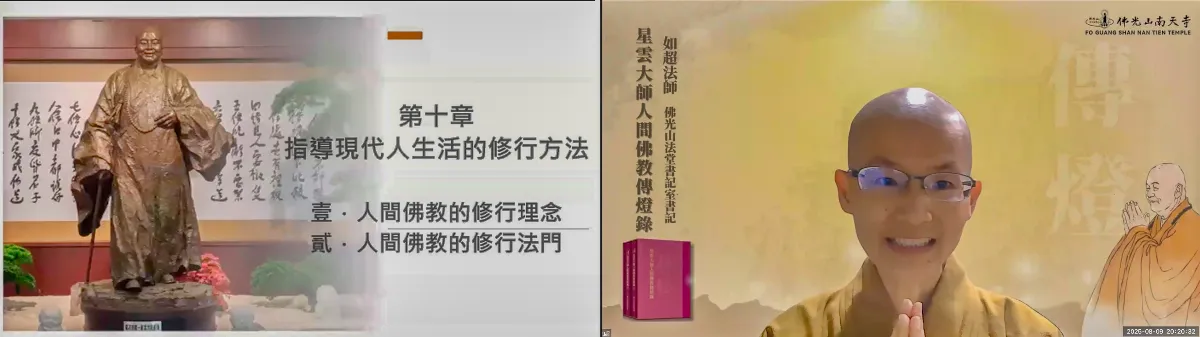
On August 9, Fo Guang Shan Nan Tien Temple hosted the Oceania online dharma lecture series on the “The Record of Passing on the Light of Humanistic Buddhism by Venerable Master Hsing Yun”. The speakers were Meng Hua Tsai, Chief Editor of the “Complete Works of Venerable Master Hsing Yun” and Associate Director of the Fo Guang Shan Institute of Humanistic Buddhism, and Venerable Ru Chao, Secretary of the Fo Guang Shan Dharma Hall Secretariat. They respectively discussed the Four Objectives for Dharma propagation formulated by the founder of Fo Guang Shan, Venerable Master Hsing Yun, and methods of Buddhist practice applicable to modern daily life.
Venerable Man Ko, Chief Abbess of Fo Guang Shan Oceania, joined by more than 200 Fo Guang Shan members, volunteers, and devotees from Sydney, Brisbane, Western Australia, Melbourne, New Zealand, Taiwan, Mainland China, and Singapore, participated in the lecture. The session was moderated by Venerable Zhi Li, Director of the Nan Tien Temple Community Education Department.
Meng Hua Tsai shared on Chapter 2, “Deeply and Broadly Advancing the Construction of Practical Undertakings of Humanistic Buddhism”, noting that the “Four Objectives” constitute a complete system of thought through which Venerable Master Hsing Yun restructured the function of Buddhism in modern society. These four are: “To propagate the Dharma through culture,” “To foster talent through education,” “To benefit society through charity,” and “To purify human minds through spiritual cultivation.” Together they form an organic structure that is mutually reinforcing and interdependent.
Speaking on the core functions, Meng Hua Tsai emphasized that the Four Objectives rest on a comprehensive “Buddhist theoretical foundation,” with “Humanistic Buddhism” as their core concept. Venerable Master Hsing Yun elevated Dharma propagation to the level of modern organizational and institutional development, establishing formal entities such as the Fo Guang Shan Compassion Foundation, the Fo Guang Yuan Art Gallery, and Nanhua University. Moving beyond traditional monastery-centred operations, he stressed group effort and the principles of “collective creation and institutional transmission.”
“How can the Four Objectives be integrated into daily life?” Meng Hua Tsai explained that Venerable Master Hsing Yun provided contemporary people with entryways into the Dharma: culture as emotional guidance, education as rational formation, charity as altruistic practice, and group cultivation as a spiritual home. One finds spiritual reliance in culture, establishes wisdom in education, practices selfless altruism in charity, and elevates faith through group cultivation. This “four-in-one” structure, spanning knowledge to values and practice to transcendence, is not only an institutional design but also a lifestyle model of Humanistic Buddhism suited to modern society.
“How should one practice after understanding the Four Objectives?” Venerable Ru Chao shared on Chapter 10, “Methods of Practice to Guide the Daily Lives of Modern People”. Venerable Master Hsing Yun advocated that life itself is practice, and that true cultivation is cultivation of the mind. To live as a Buddhist is to practice the Buddha’s teachings in daily life, faithfully putting them into action. The purpose of cultivating the mind is to purify it, to collectively build a Pure Land on earth, and to enable everyone to directly experience the joy of the Dharma and peace of mind.
Venerable Ru Chao introduced various methods of practice described in Chapter 10, including religious life, moral life, and disciplined life. She emphasized that the practice methods established by Venerable Master Hsing Yun are equal in significance—any door can lead to the path as long as one has faith. Thus, one must seize the present moment, with “being a good person” as the foremost principle, and advance toward Buddhahood through the continual betterment of oneself.
This lecture enabled participants to gain deeper understanding of the core ideas of the Four Objectives, strengthening their resolve to implement Humanistic Buddhism in everyday life. Upholding the principle of “Buddhism in daily life, daily life as Buddhism,” the seeds of Humanistic Buddhism continue to be cultivated in Oceania, blossoming and bearing fruit in the Southern Hemisphere to benefit all sentient beings with karmic affinity.
評論(0)
目前沒有評論,歡迎分享您的看法。
登入會員後即可發表評論、回覆及讚。