


Sioh Yang Tan
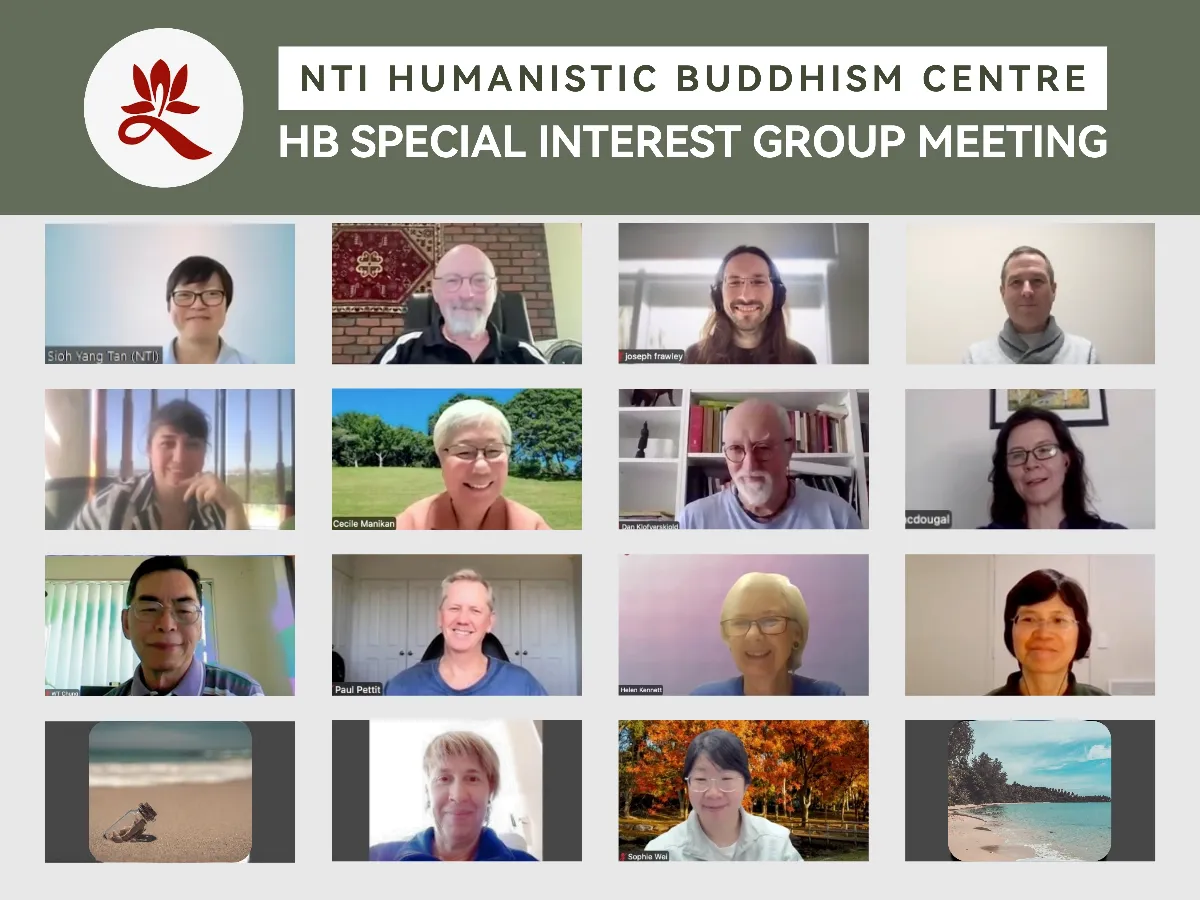
On October 14, the Humanistic Buddhism Special Interest Group (HB SIG), hosted by the Humanistic Buddhism Centre at Nan Tien Institute, convened its third online meeting in 2025, continuing its mission to foster a supportive platform for scholars to connect, exchange ideas, and collaborate on research projects related to Humanistic Buddhism.
Among those present were Dr Nadine Levy, Head of Program (Health and Social Wellbeing), and Dr Elizabeth McDougal, Lecturer in Buddhism at Nan Tien Institute, who joined the discussion alongside 18 other participants from across Australia, Malaysia, New Zealand, the Philippines, and Singapore.
In “Onya Nun! Theravāda Bhikkhunīs in Australia”, Dr Roy Sneddon from the University of Adelaide presented his doctoral research, drawing from fieldwork conducted across Western Australia, Victoria, South Australia, and New South Wales. Dr Sneddon’s study documented the experiences of ordained female monastics and their evolving roles in Australia’s Buddhist landscape. Through extensive interviews with monastics and lay followers, the study sought to centre voices historically marginalised in Buddhist scholarship.
Bhikkuni interviewees talked about the challenges of limited access to experienced teachers due to the relative youth of the lineage in Australia. Notably, Bhikkunis often have to serve two communities, traditional Buddhists with cultural needs and Western Buddhists seeking teachings in modern formats, while striving to deepen their own practice.
Lay Interviewees stressed the importance of engaging younger generations, including the children of traditional Buddhists, in a Buddhism relevant to contemporary Australian society, one that embodies gender equality and inclusivity.
Dr Sneddon explained that his methodology was inspired by Aboriginal yarning, an approach that builds trust and allows participants to guide the research process. “We consulted senior monastics from the start,” he said. His findings challenge assumptions from studies in traditional Buddhist countries, where temples are ubiquitous, noting that Australian Bhikkhunīs face unique geographic isolation. Despite challenges, interviewees consistently affirmed that “Australia is a wonderful place to be a Bhikkhunī.”
In the second presentation, Joseph Frawley, Project Engagement Officer at Nan Tien Institute, delivered “Holding Paradox: A Madhyamika Reorientation of Multicultural Discourse.” Engaging with European scholarship on multiculturalism, Frawley identified recurring paradoxes in identity, social cohesion, and governance, where attempts to resolve one problem often generate new ones.
Drawing on the Buddhist principles of Middle Way, Dependent Origination, and Sunyata or Emptiness, he proposed “holding paradox” rather than seeking premature resolution. Through this lens, Buddhist thought offers fresh pathways for navigating diversity and coexistence in pluralistic societies. In the discussion that followed, Frawley reflected on his personal experience in multicultural settings, and how Buddhist ideas transformed his views and actions. There were also robust discussions on how a Buddhist-informed approach may impact multicultural policies and governance in real-life settings.
Through such interdisciplinary dialogue, the HB SIG continues to nurture meaningful conversations that bridge academic inquiry with lived Buddhist experience. Open to scholars, students, and practitioners, the group remains committed to deepening understanding of Humanistic Buddhism and its relevance in today’s interconnected world. HB SIG is part of a project funded by the Hsing Yun Education Foundation.
For more information on the HB SIG and upcoming meetings, visit: https://www.nantien.edu.au/about-us/humanistic-buddhism-centre/research/sig/
評論(0)
目前沒有評論,歡迎分享您的看法。
登入會員後即可發表評論、回覆及讚。