

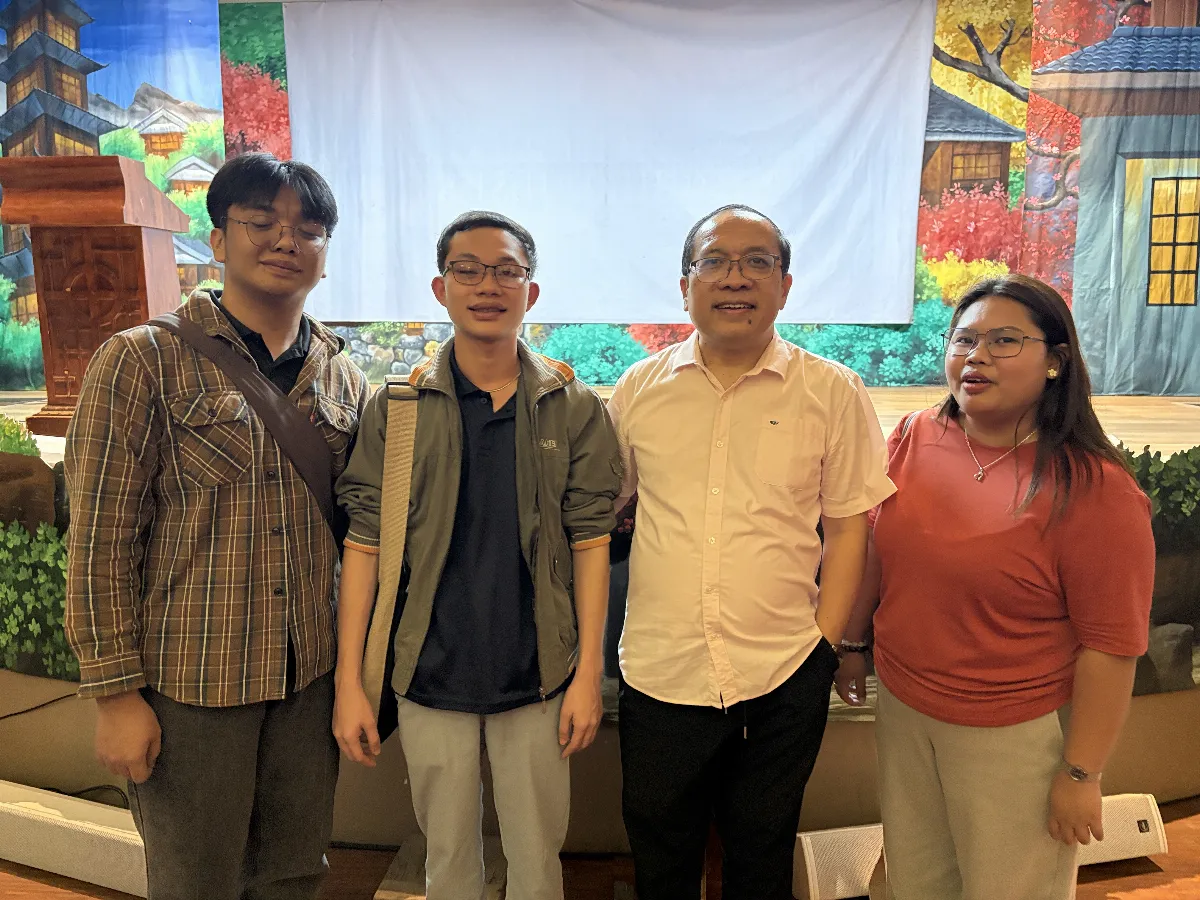
CEBU, Philippines — The Department of Philosophy of the University of San Carlos (USC), together with the Academic Development Office of the Humanistic Buddhism Center Philippines, hosted the 2nd Romualdo Abulad SVD Philosophy Colloquium “Translations and Meanings: Philosophy, Language, and Religion” an interfaith academic forum at the San Carlos Seminary College. The event builds on a Memorandum of Understanding signed last year between USC and the Fo Guang Shan Institute of Humanistic Buddhism (IHB), expanding into a broader dialogue across theology, philosophy, and Buddhist Studies.
The forum opened with welcoming remarks from Rev. Fr. Alvin Raypan, Rector of the San Carlos Seminary College and the Chairman of the Ecumenism Council of the Archdiocese. He underscored that translation is more than linguistic competence—it is foundational to both philosophical inquiry and religious understanding. “Through translation,” he noted, “human beings cross cultural boundaries and rediscover the meaning of faith, history, and existence.” He encouraged students and faculty to listen with openness to wisdom from diverse traditions.
Prof. Maje Purino then initiated the colloquium by honoring the memory of the late Br. Romualdo “Romy” Abulad, SVD, Ph.D. whose legacy continues to shape Philippine philosophy. She reflected on the privilege and difficulty of paying tribute to a mentor whose intellectual depth and moral discipline profoundly influenced generations of students and scholars. Recalling his expertise on Kant, his rigorous teaching, and his unwavering commitment to philosophical duty, she emphasized that Br. Abulad exemplified a life rooted in good will. Her remarks situated the forum within a tradition of reflective inquiry, inviting participants to approach translation as a philosophical and ethical vocation.
Three speakers then offered perspectives from pastoral ministry, continental philosophy, and Buddhist Studies—together illustrating how translation serves as a bridge toward truth.
The first lecture, delivered by Rev. Fr. José Adonis “Dondon” Aquino of the Archdiocese of Cebu, delivered a deeply reflective presentation rooted in his decades-long pastoral and linguistic work translating the Holy Bible into Cebuano. He emphasized that translation, particularly of sacred texts, is never a mere technical operation but an act of pastoral care—one that allows the Word of God to genuinely dwell within people’s daily lives. Rev. Fr. Aquino illustrated how language choices shape theological comprehension, spiritual intimacy, and people’s sense of belonging in their faith. When Scripture is accessible in one’s home language, it becomes a companion in prayer, suffering, celebration, and moral discernment.
He also reflected on the complexities of linguistic nuance, revealing how mistranslations—however small—can distort doctrine, disorient worshippers, or weaken the spiritual authority of the text. Through examples drawn from liturgy and Biblical passages, he demonstrated that a translator must balance fidelity to original meaning with the spoken rhythms of lived faith. More broadly, Rev. Fr. Aquino presented translation as a pastoral mission that democratizes spiritual knowledge, strengthens the cultural identity of communities, and ensures that divine revelation resonates with people in a way that is both intimate and transformative..
The second presentation, by Dr. Charito Pizarro of USC, explored translation as a fundamental mode of human existence. Drawing from Martin Heidegger’s Being and Time, she argued that translation is not merely linguistic transfer but an existential act that shapes how human beings interpret themselves and their world. She explained that Heidegger’s concept of Dasein—“being-in-the-world”—means that language is the medium through which individuals access meaning, confront temporality, and make sense of their own finitude and possibilities.
Dr. Pizarro further elaborated on the “hermeneutic circle,” emphasizing that understanding always moves between parts and wholes: between personal experience and inherited tradition, between text and interpreter, between past meanings and future possibilities. Translation, she suggested, is precisely this movement—it allows concepts from one linguistic horizon to illuminate another, thereby reshaping the structure of understanding. Through detailed analysis, she argued that every translation is an existential decision: what is emphasized, what is softened, what is preserved, and what is transformed. These choices determine not only meaning but the lived experience of meaning. For Dr. Pizarro, translation thus becomes a philosophical practice, opening new pathways into the question of being itself.
The final lecture was delivered by Venerable Miao Guang, Deputy Director of the Fo Guang Shan Institute of Humanistic Buddhism, presented a sweeping historical and doctrinal exploration of translation within Buddhism, highlighting how the religion’s global expansion has always depended on the compassionate transmission of meaning across languages, cultures, and epochs. She traced the Buddha’s own teaching style—delivered in multiple dialects rather than elite Sanskrit—as the earliest model of accessible translation motivated by compassion. As Buddhism spread across Asia, translation bureaus flourished, producing canonical collections, new philosophical vocabularies, and cross-cultural syntheses that reshaped Chinese, Korean, Japanese, and later Western intellectual history.
Drawing from her leadership in the Fo Guang Dictionary of Buddhism English Translation Project, Venerable Miao Guang examined how AI is now transforming Buddhist textual work. AI, she explained, can instantly search canonical corpora, identify doctrinal patterns, compare translations, and reveal linguistic structures that once required years of human labor. This accelerates research and widens global accessibility. However, she cautioned that AI remains an instrument, not a knowing subject. It cannot experience suffering, cultivate compassion, meditate, or understand emptiness in the experiential sense. Its analytical capabilities may bring users closer to the words of truth, but not to the lived realization of truth. Genuine spiritual insight, she emphasized, still rests in human wisdom, ethical clarity, and disciplined practice. Thus, she argued for a model of partnership—uniting technological power with human cultivation, allowing the Dharma to enter the modern world with both fidelity and renewed vitality.
The event concluded with the presentation of certificates of appreciation by Prof. Maje Purino, forum convenor, and Venerable Miao Jing, Abbess of Fo Guang Shan Mabuhay Temple, acknowledging the speakers’ contributions to interreligious education.
In parallel with the academic collaboration, Fo Guang Shan Cebu Chu En Temple continues its joint programs with USC Department of Philosophy’s Community Extension Service (CES), including interfaith learning courses and community-based “Three Acts of Goodness” initiatives. Recent community activities—ranging from first-aid training and stress management workshops to cooking, Zumba, and livelihood skills—reflect both institutions’ shared commitment to holistic community service.
The forum highlighted how language, technology, and philosophy can converge to deepen mutual understanding—and how translation, across traditions and centuries, continues to open new pathways toward truth.
評論(0)
目前沒有評論,歡迎分享您的看法。
登入會員後即可發表評論、回覆及讚。